
Why I keep coming back to strong foundations.
The maths that helped me most started with something simple: feeling comfortable with numbers.
I grew up in Shanghai, where maths was one of my stronger subjects. I enjoyed finding patterns, trying different approaches and working out why an answer made sense. When I moved to New Zealand for high school, I began to realise how valuable that early practice had been.
Interestingly, until around Year 10, I rarely did schoolwork at home. I usually finished it during class or spare time at school. What mattered was the practice I had already put in: plenty of time spent on calculations, recognising patterns and thinking through problems.
Those foundations stayed with me. They also shaped what I now value most when helping students learn.
In my teaching in Australia, I have noticed that some students reach more demanding topics while still finding basic calculations or fractions difficult. Understanding a new concept becomes much harder when the calculations underneath it keep getting in the way. Often, those earlier skills deserve attention before we add more complexity.
Primary school: make numbers feel natural
For younger children, I want numbers to become familiar enough that they can use them with confidence.
Multiplication, division and fractions keep appearing throughout school. When these skills are dependable, students have more attention available for understanding the problem in front of them.
These are the foundations I pay particular attention to:
- Mental maths: calculating accurately and efficiently, with useful strategies to fall back on.
- Number sense: estimating, comparing quantities and noticing when an answer looks wrong.
- Essential concepts: understanding operations, fractions, percentages and basic geometry.
- Patterns and reasoning: spotting relationships and explaining how one step follows from another.
Building these skills takes regular, purposeful practice. I want students to understand what they are doing and become comfortable enough to use it independently. That combination makes later learning more manageable.
Senior school: build on what is already there
Senior maths brings several ideas together within one question. Reliable algebra, calculation and reasoning skills help students tackle this work, alongside organised revision and exam practice. Those same foundations also support subjects such as physics and chemistry, where equations, proportions and graphs help explain what is happening.
Strong roots make room to grow
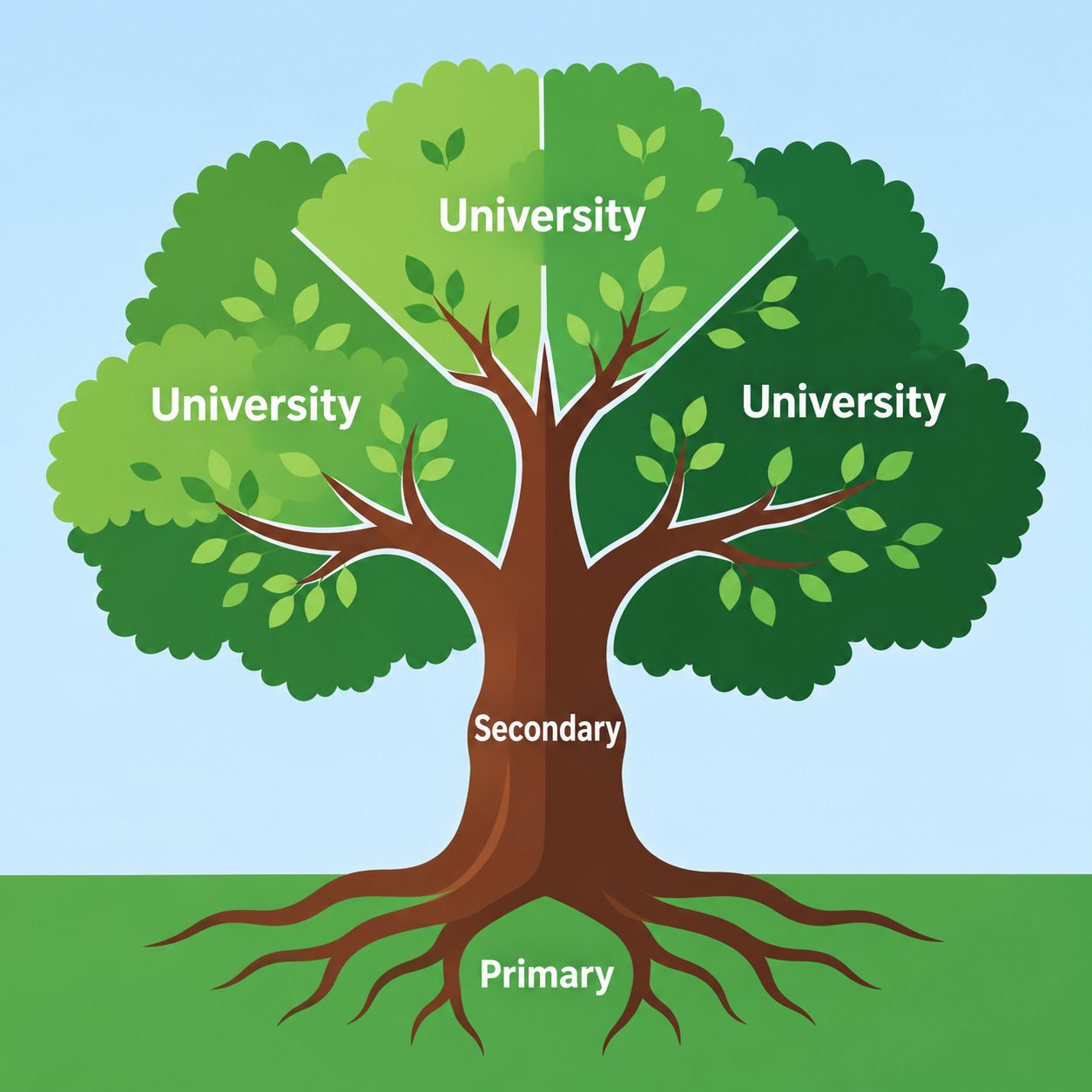
I think of maths like the tree pictured above. Primary learning provides the roots. Later learning grows from them, gradually opening into different branches.
Maths is cumulative: each new idea draws on something learned before. When those early skills are secure, students can connect new concepts more easily and keep building with confidence. That is why I place so much value on getting the foundations right.